
When shipping goods internationally, moisture damage can be a costly problem. Condensation, commonly known as container rain, can cause mould, rust, corrosion and damaged packaging.
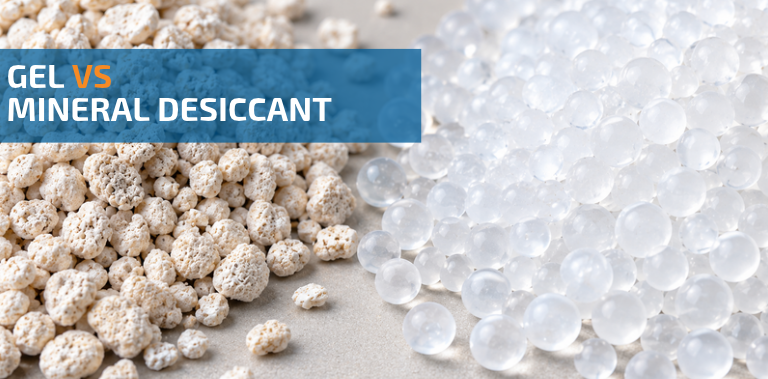
Choosing the right shipping container desiccant is essential, but is gel desiccant better than mineral desiccant? Let’s explore Gel desiccant vs Mineral desiccant by comparing their performance, installation costs and environmental considerations.
Gel vs Mineral Desiccant: What’s the Difference?
Both gel and mineral desiccants absorb moisture from the surrounding air, helping protect cargo during shipping and storage. However, their moisture absorption capacities differ significantly.
Pro-Ex Gel Desiccant uses a high-performance calcium chloride and starch formulation that absorbs up to 300% of its own weight in moisture.
In comparison, Pro-Ex mineral desiccants, made with calcium chloride and montmorillonite clay, absorb up to 70% of their weight.
| Feature | Pro-Ex Gel | Mineral Desiccant |
|---|---|---|
| Maximum absorption | Up to 300% | Up to 70% |
| Moisture absorbed per 1kg | Up to 3 litres | Up to 700ml |
| Installation | Hanging bags | Hanging bags available |
| Main advantage | High absorption with fewer bags | Lower purchase price per unit |
Absorption figures represent maximum capacities under suitable conditions. Actual performance varies with humidity and temperature.
Fewer Desiccants Mean Less Labour
One of the biggest advantages of Pro-Ex Gel is its high moisture absorption capacity.
Because each bag can absorb significantly more moisture by weight, fewer bags may be needed to achieve the required moisture protection.
This can mean:
- Lower labour costs — fewer desiccants to hang during container loading.
- Faster installation — less time preparing containers for shipment.
- Less handling — fewer bags to remove at the destination.
- Reduced waste — potentially less desiccant material and packaging to dispose of.
For businesses regularly exporting shipping containers, these efficiencies can add up over time.
What Happens to the Absorbed Moisture?
Pro-Ex Gel doesn’t simply collect water. As moisture is absorbed, it transforms into a stable gel, helping minimise the risk of liquid leakage and re-evaporation.
This makes it particularly useful for protecting moisture-sensitive cargo, including furniture, textiles, machinery and packaged goods.
Pro-Ex Gel 500g or 1kg: Which Should You Choose?
Pro-Ex Gel is available in two convenient sizes:
- PGel-500g: Absorbs up to 1.5 litres of moisture, offering flexibility when positioning smaller bags throughout a container.
- PGel-1kg: Absorbs up to 3 litres of moisture, potentially reducing the number of bags required and installation time.
Both offer the same maximum 300% moisture absorption capacity and convenient hanging installation.
So, Is Gel Desiccant Better Than Mineral Desiccant?
For high-humidity shipments and businesses looking to reduce installation time, Pro-Ex Gel can offer significant advantages.
While mineral desiccants remain an economical option for many applications, Pro-Ex Gel’s superior maximum absorption capacity can help businesses achieve effective moisture protection with fewer bags.
Protect your cargo. Reduce handling. Make every desiccant count.
Explore our Pro-Ex Gel 1kg Shipping Container Desiccant or contact Protection Experts Australia for advice on choosing the right desiccant for your next shipment.